

October Quarterly Newsletter - 2026
Highlights of this Special Edition Newsletter:
LVM's Year-End Financial Planning Checklist
LVM Staff Anniversary
State of the Housing Market
Clients Giving Back

LVM’s Year-End Financial Planning Checklist
Required Minimum Distributions (RMDs)
Required Minimum Distributions (RMDs) generally are minimum amounts that a retirement plan account owner must withdraw annually, starting with the year that he or she reaches the age of 73. The RMD is calculated for each IRA or retirement plan account by dividing the prior December 31 balance by a life expectancy factor that the IRS publishes. LVM and most custodians encourage you to complete these distributions before December 1 to ensure distributions are made before year-end.
Qualified Charitable Distributions (QCDs) IRA owners over the age of 70½ are allowed to satisfy all or a portion (up to $111,000) of their RMD with a direct transfer to a qualified charity. Each spouse is allowed their own QCD from their own IRA. Unlike regular IRA withdrawals, QCDs are excluded from your taxable income, which can lower overall taxes paid and may help you keep certain tax credits. Managing your tax bracket may also help reduce future Medicare premiums. The December 1 distribution timeline also applies for QCDs. If you are writing checks directly from the IRA, they must clear before year end.
Maximize Retirement Contributions
In 2026, you can contribute $24,500 to your 401k or other employer-sponsored retirement plan. An extra $8,000 in “catch-up” contributions are allowed if you will be 50 to 59 or 64+ this year. The “catch-up” contribution is $11,250 for ages 60 to 63.
Even if you do not have an employer-sponsored plan, you may still be able to contribute up to $7,500 ($8,600 if you’re 50 or older) to a traditional IRA. These rules also apply to nondeductible IRA and Roth IRA contributions. “Backdoor” Roth contributions are also available for higher income earners if you are phased out from making direct contributions to a Roth IRA. Defined contribution plans allow higher contributions of up to $72,000 or 25% of your qualified income (whichever is less).
Tax-Loss Harvesting
Tax-loss harvesting is a strategy used to reduce overall capital gains taxes paid by selling securities you hold at a loss. Tax losses can be used to offset gains you may have in the account or gains from selling real estate or a business. Annually, you can use $3,000 of capital losses to offset income, and you can carry forward any losses above and beyond the $3,000 for future use.
Other Items to Discuss with your Financial Advisor • College education savings (contributions to 529 plans)
• Health Savings Account (HSA) contributions ($4,400 self-only; $8,750 family, plus $1,000 for 55 and older “catch-up” provision)
• Making gift-tax exclusion gifts to non-charitable recipients (children, grandchildren, other family or friends) of up to $19,000/recipient ($38,000/recipient from a couple)
• Reviewing life insurance coverage and estate planning documents including Trusts, Wills, Health Care Proxy, and Financial Power of Attorney
LVM Staff Anniversary

State of the Housing Market
The world of markets and personal finance has spilled a lot of ink over the last few years about the housing market, so we assume readers are familiar with the broader picture of a sluggish real-estate environment. Unfortunately, not much has changed. High 30-year mortgage rates relative to the last 10 to15 years (6.7% as of early September)—coupled with the median home price above $400,000—have depressed sales and kept most buyers on the sidelines. Only 7% of households moved to a new address last year, a 25-year low.
Apollo Global Management updated their housing report in September and concluded that almost 75% of prospective buyers could only afford homes below $300K, based on a 6.5% interest rate, a 10% down payment, and assuming housing costs are capped at 28% of income.
That dour point is illustrated below. The national home price index has increased nearly 90% over the last 10 years, while nominal wages have risen only about 50%.
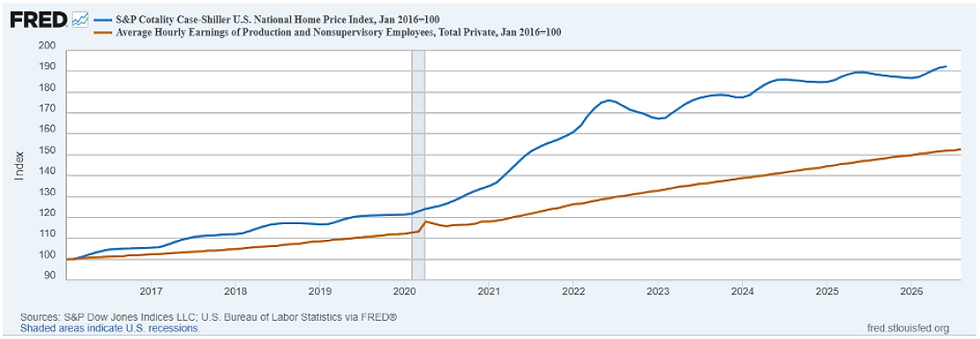
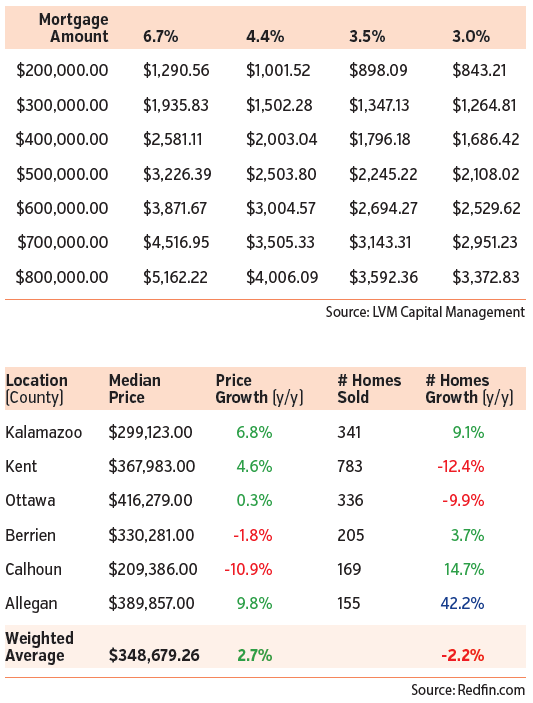
Home prices rose sharply in the post-pandemic period. Income growth has also posted solid nominal gains over that stretch, but it's arguably the rise in interest rates that has made home purchases even more burdensome for many buyers.
The chart at the right shows the monthly payment differences between today’s rates at 6.7% compared to the 4.4% national average mortgage rate among current homeowners, the 3.5% average rate in Fall 2019, and the 3.0% rate—or lower—that many homeowners were able to lock in at points throughout 2020-2021.
Yet while this has been painful for prospective buyers, there has been a silver lining to many current homeowners. Not only does this cohort hold record amounts of household equity ($35 trillion as of July), but most also took advantage of refinancing to a lower interest rate while they were available. Real-estate analyst Bill McBride cites almost 50% of outstanding mortgages have a rate below 4% and, astonishingly, around 20% of current mortgages have a rate below 3%. At the median home price of ~$350,000 in 2021, that’s nearly $800 per month in savings vs. today’s buyers.
It’s these more fortunate homeowners who continue to prop up the current buying environment. Home sales and inventory levels are still below pre-pandemic trends, but there are signs of life in various markets, since real estate norms are nothing if not local trends.
And crucially, it’s record home equity amounts that have allowed many long-time homeowners to avoid the back-breaking monthly payment increases that higher rates have borne. Just as pricing
and sales data are all local, of course, so are home equity levels. For instance, Californian homeowners on average hold home equity values of ~$626K—enough to make an all-cash offer on a median priced home in 48 out of 50 states. In fact, a Californian homeowner could purchase a Florida ($355K median price) or Texas ($308K median) home outright and still have nearly $300K or more in excess proceeds.
All of this has implications for financial markets and the broader economy as well. As households
refinanced their mortgages and moved during the post-pandemic period—upgrading to more spacious homes, relocating across state lines to be closer to family, or pursuing a lifestyle better suited to their needs—much of this accumulated home equity, along with the monthly savings unlocked through refinancing, found its way into financial markets. Some of it flowed into equities in pursuit of long-term growth, while other funds moved into bonds and other fixed-income assets to capture higher yields.
Ultimately, it is far too early to predict the financial impacts that delayed household formation in
younger generations may have. But the affordability crunch in real estate has pushed younger folks’ excess savings into financial assets at a faster pace than their older peers, which historically speaking, bodes well from an investment return perspective. Even still, there is an intangible, psychological aspect to home ownership that Americans have always aspired to. It’s likely that as long as that dream feels out of reach to many, we may continue to see discontent in economic survey data.

IMPORTANT DISCLOSURE
LVM Capital Management, Ltd. is a registered investment advisor with the U.S. Securities and Exchange Commission. Registration of an Investment Advisor does not imply any level of skill or training. The information presented is not specific to any individual’s personal investment, tax, or legal circumstances. Individuals should seek specific investment, tax, and legal advice from qualified advisors. The information provided is neither written nor is it intended to be used to avoid penalties that may be imposed by law. These articles are provided for general information and educational purposes and are based on publicly available sources believed to be reliable. LVM does not guarantee the accuracy or completeness of the materials. LVM is not responsible for errors of fact. Information contained herein may change at any time and without notice.
Comments